
Uncategorized
Most Collectible Vintage King Seiko Models
May
Most Collectible Vintage King Seiko Models That Deserve Your Attention
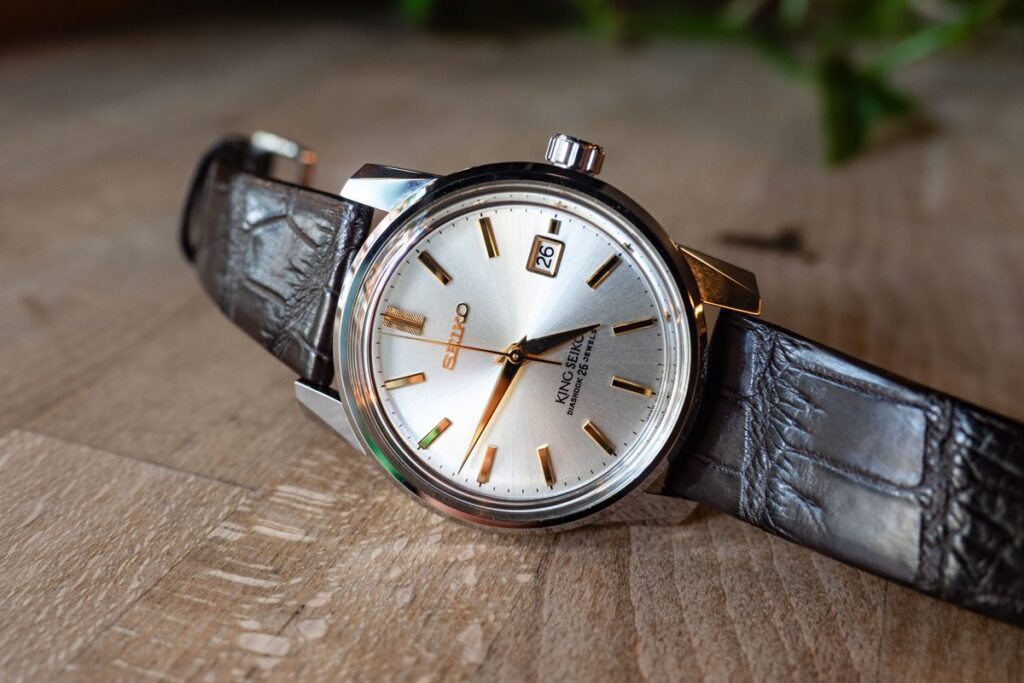
Zaratsu polishing separates a King Seiko from nearly every other mid-century dress watch ever produced. That mirror-flat distortion-free finish — applied by hand at the Suwa and Daini factories — gave these pieces a visual authority that collectors now chase with real intensity. Between 1961 and 1975, Seiko’s domestic luxury line delivered mechanical precision that rivaled Swiss chronometer standards at a fraction of the cost. Today, the secondary market reflects what enthusiasts figured out years ago: certain King Seiko references represent extraordinary value, and their prices climb each season.
I have handled dozens of these watches over three decades, and the zaratsu polishing on a well-preserved example still stops me cold. The case sides catch light like polished obsidian. No machine replicates that effect — it demands a trained human hand pressing steel against a tin-alloy plate. That craftsmanship anchors every model on this list. If you are building a vintage collection or simply want one exceptional dress watch, these are the references worth pursuing right now.
This guide covers the most sought-after King Seiko references from the Grammar of Design era, with current market context and practical buying notes for each model.
The Grammar of Design — Why King Seiko Cases Matter
Taro Tanaka’s “Grammar of Design” philosophy shaped every King Seiko case from the mid-1960s onward. The concept treated each surface plane as a distinct element in a visual sentence. Flat planes met sharp ridges without curves or fillets. Zaratsu polishing turned those flat planes into mirrors, while brushed surfaces on the top created contrast. That interplay — mirror side, matte top, razor edge between them — became the King Seiko signature.
The technique traces back to sword polishing. Japanese bladesmiths used similar flat-plate methods to achieve the hamon line on katana steel. Seiko adapted that tradition for wristwatch cases in the 1960s, and the Suwa factory maintained dedicated zaratsu workshops where artisans spent years mastering the skill before touching production pieces. Each case required roughly 30 minutes of hand polishing — a commitment that modern mass production rarely permits.
Collectors who examine King Seiko cases under a loupe notice something particular: the polished surfaces show zero convexity. Unlike buffing wheels that round edges and create slight distortion, zaratsu polishing preserves geometric accuracy. That flatness is what makes original unpolished examples so prized. A case that has been refinished on a buffing wheel loses its zaratsu character permanently, and experienced buyers check for this immediately. Vintage GS/KS community discussions regularly feature comparison photos showing the difference between original zaratsu and wheel-polished surfaces.
Top Collectible King Seiko References — Ranked by Market Demand
44-9990 — The Original King Seiko Chronometer
The 44-9990 launched King Seiko as a serious contender in the accuracy wars against Grand Seiko. Known among collectors as the “KSK,” this reference housed the manually wound Cal. 4420A — a movement that the Daini Seikosha factory tuned to chronometer-grade accuracy. The flat dial with applied hour markers, dauphine hands, and the proud “Chronometer” text below the King Seiko logo make this reference instantly recognizable.
Case condition drives pricing dramatically on the 44-9990. Because zaratsu polishing defines every visible surface, any buffing or amateur polishing destroys the watch’s character. Collectors pay a steep premium — sometimes double — for examples with original sharp edges intact. The lugs on this model taper gracefully, and that taper disappears under a polishing wheel. Check the junction between polished and brushed surfaces: if that line is soft or rounded, the case has been reworked.
At current market rates, a well-preserved 44-9990 with original crystal and dial fetches between $2,500 and $4,500 depending on condition. Five years ago, you could find clean examples under $1,000. That trajectory tells you where the market is heading. The 2022 re-release of King Seiko as a modern line brought fresh attention to these originals, and supply of unpolished examples dwindles each year.
45-7001 — Peak Grammar of Design
If one King Seiko reference captures the Grammar of Design at its absolute peak, it is the 45-7001. The case architecture on this watch features six distinct planes on each side — an extraordinary level of geometric ambition for a 37mm dress watch. The Cal. 4500A automatic movement provided 25 jewels and a quickset date, making it a daily-wear candidate that also happened to be a visual masterpiece.
The 45-7001 wears its zaratsu polishing with particular drama because of those multiple planes. Light catches each surface at a different angle, creating a shifting pattern of reflections as the wrist moves. I remember the first time I turned a mint-condition 45-7001 under a desk lamp — the case seemed to flash like a signal mirror. That optical effect only happens when the original geometry is preserved.
Dial variations on the 45-7001 add another layer for collectors. The silver sunburst dial is most common, but blue and champagne versions surface occasionally. Blue dials in original condition command roughly 40% more than silver equivalents. All share the same applied faceted indices and thin dauphine hands that define the King Seiko aesthetic. The specialist dealers who focus on vintage Seiko track these variants carefully and maintain waiting lists for specific dial colors.
Collector’s Tip: The 45-7001 shares its case with the 45-7000, but the 7001 features a different dial layout and date window position. Do not confuse the two — the 7001 is scarcer and typically valued 20-30% higher in equivalent condition.
56KS Series — The Hi-Beat Transition
The 56KS references (5625-7000, 5626-7000, and their variants) marked King Seiko’s transition to hi-beat movements running at 28,800 vibrations per hour. The Cal. 5625A hand-wound and Cal. 5626A automatic movements delivered smoother seconds hand sweep and improved timekeeping accuracy compared to the earlier 44 and 45 caliber pieces.
Case design on the 56KS models evolved toward slightly larger proportions and softer geometry. The Grammar of Design influence remains visible — flat planes and sharp transitions — but the overall aesthetic feels a touch more modern than the angular 45-series pieces. Some collectors prefer this refinement. Others feel it diluted the pure geometric vision. Either way, the 56KS models offer genuine zaratsu polishing at lower entry prices than the earlier references.
The 5625-7000 in particular has gained traction among newer collectors. Its silver dial with applied stick markers and the day-date complication at three o’clock provide good wrist presence. Manual winding via the Cal. 5625A gives it a mechanical intimacy that automatic movements lack — you feel the mainspring tension build through the crown each morning. That ritual connects you to the watch in a way that strapping on a self-winder does not.
King Seiko Vanac — The Bold Late Models
The Vanac sub-line appeared in the early 1970s as King Seiko pushed toward bolder case designs. The 5626-7111 and 5626-7113 feature faceted cases with wide angular lugs that reflect 1970s design confidence. These watches wore larger — 38mm was substantial for the era — and their cases showcase zaratsu polishing across broad, dramatic surfaces.
Vanac dials are where things get interesting for collectors. Seiko produced these with textured dials in green, blue, brown, and metallic grey. The green-dial Vanac has become a genuine cult piece. Its color shifts between forest green and near-black depending on the light, and clean examples now sell for three to four times what they fetched in 2019. The community resources on vintage Seiko have documented over 15 dial variations across the Vanac range.
Mechanically, the Vanac models use the proven Cal. 5626A automatic with day-date display. The movement is robust and service-friendly — any competent watchmaker can maintain it with readily available parts. That practicality matters for a vintage watch you actually intend to wear rather than display in a case.
Condition Grading — What Zaratsu Polishing Tells You
Insight: A King Seiko with original zaratsu polishing intact is worth significantly more than a refinished example — even if the refinished piece looks “shinier.” Buyers at auction houses and specialist dealers test for original polishing by examining edge transitions under magnification. A flat reflection that stays undistorted as you tilt the watch signals authentic zaratsu work.
Buying Strategy — Where to Find King Seiko Originals
Japanese domestic auction sites remain the richest source for vintage King Seiko models. Yahoo Japan Auctions lists dozens of examples weekly, though navigating the platform requires either Japanese language ability or a proxy buying service. The advantage is access to watches that never left Japan — many still carry their original bracelets, boxes, and even warranty papers.
Western markets have caught up in recent years. Chrono24, eBay Japan sellers, and specialist vintage Seiko dealers in the US and Europe now stock curated examples. Pricing runs 20-40% higher than Japanese domestic sources, but you gain buyer protection and English-language descriptions. The trade-off is reasonable if you are not comfortable navigating Japanese auction logistics.
Private collector sales — through forums, Instagram accounts, and dedicated communities — often surface the best examples. Serious King Seiko collectors tend to maintain their pieces properly, store them carefully, and document provenance. A watch purchased from a knowledgeable collector typically arrives in better condition than a random auction find, and the seller can usually tell you the service history.
Regardless of source, always request macro photos of the case sides. You want to see the zaratsu polishing planes clearly. Ask for a photo taken at an angle that catches light along the case flank — this reveals whether the mirror finish and edge transitions are original. If the seller cannot or will not provide these photos, move on. There are enough examples circulating that you need not settle for uncertainty.
Service and Maintenance Considerations
Vintage King Seiko movements are robust and service-friendly, but finding a watchmaker who respects the case finishing requires care. General-purpose watchmakers often polish cases on a buffing wheel as part of a standard service — this destroys zaratsu finishing permanently. Before handing over your watch, explicitly instruct the watchmaker to leave the case untouched. Written instructions help. Some collectors even tape over the case before submitting the watch for movement service.
Movement parts remain available for most King Seiko calibers. The 44-series and 45-series share components with the broadly produced Seiko movements of that era. The 56-series calibers are even better supported. A full service — disassembly, cleaning, re-lubrication, regulation — typically costs between $150 and $300 depending on the watchmaker and your location. That is remarkably affordable compared to servicing vintage Swiss movements of similar age.
Crystal replacement is straightforward for most references. Original mineral glass crystals can be replaced with period-correct equivalents from aftermarket suppliers. Some collectors upgrade to sapphire for daily-wear durability, though purists argue this changes the watch’s visual character. The original mineral crystals have a particular warmth and light transmission that sapphire does not replicate exactly.
Verdict: King Seiko represents one of the strongest value propositions in vintage watchmaking. You get hand-finished cases with zaratsu polishing, accurate mechanical movements, and historically significant design — at prices that remain accessible compared to equivalent Swiss vintage pieces. The market is rising, but entry points still exist across the range.
Investment Trajectory — Where Values Are Heading
King Seiko prices have followed a consistent upward curve since approximately 2018. The catalyst was twofold: Seiko’s modern relaunch of the King Seiko brand introduced the name to new audiences, and a broader market shift toward Japanese vintage watches drew collector attention away from overcrowded Swiss categories. Neither factor shows signs of reversing.
The 44-9990 KSK has appreciated roughly 300% over five years. The 45-7001 and Vanac green dial have followed similar trajectories. Even the more common 56KS models have doubled in average transaction price. This appreciation reflects genuine scarcity — these watches were produced in limited numbers for the Japanese domestic market, and attrition from wear, damage, and poor servicing reduces the surviving population each year.
For collectors entering now, the sweet spot may be the 56KS references and the non-green Vanac variants. These models carry authentic zaratsu polishing and solid hi-beat movements at prices that still allow comfortable entry. As the top-tier references push beyond $5,000, these mid-range models will absorb increased demand from collectors priced out of the 44 and 45-series pieces.
Frequently Asked Questions
What makes zaratsu polishing different from standard case polishing?
Zaratsu polishing uses a flat tin-alloy plate rather than a rotating buffing wheel. The watchmaker presses the case surface against this flat plate by hand, which preserves geometric accuracy and creates a mirror finish without convexity. Standard buffing wheels round edges and create subtle surface distortion that zaratsu avoids entirely. The technique originates from Japanese sword polishing traditions and requires years of training to master.
How can I tell if a King Seiko has been re-polished?
Examine the transitions between polished and brushed surfaces on the case. Original zaratsu work creates knife-edge transitions — the line between mirror and matte is abrupt and perfectly straight. A re-polished case shows soft, rounded transitions where the buffing wheel has blended the two surface textures together. Also check for convexity on the polished surfaces by observing how straight lines reflect in them — original zaratsu shows zero distortion.
Are King Seiko watches accurate enough for daily wear?
Yes. A properly serviced King Seiko typically keeps time within 10-15 seconds per day, which is accurate enough for daily use without constant resetting. The chronometer-rated models like the 44-9990 can perform even better after regulation. The hi-beat 56KS calibers benefit from their higher frequency, which makes them less sensitive to positional variation throughout the day.
What is the difference between King Seiko and Grand Seiko?
Both lines were Seiko’s premium domestic offerings, but they came from different factories. Grand Seiko was produced at the Suwa Seikosha facility, while King Seiko came from Daini Seikosha. The two factories competed intensely for accuracy records during the 1960s. Grand Seiko focused on ultimate precision and conservative design. King Seiko emphasized case design and the Grammar of Design philosophy, producing more architecturally ambitious cases with elaborate zaratsu polishing.
Should I buy a King Seiko as an investment?
King Seiko values have appreciated steadily over the past five years, particularly for the top references like the 44-9990 and 45-7001. Buy the best condition you can afford, prioritize original unpolished cases, and keep documentation of provenance and service history. No watch purchase is a guaranteed investment, but the combination of rising collector interest, limited surviving examples, and increasing brand awareness suggests continued appreciation for well-preserved pieces.