
Watch
King Seiko vs Grand Seiko: History, Rivalry & Collecting Guide
Apr
King Seiko vs Grand Seiko: History, Rivalry & Collecting Guide
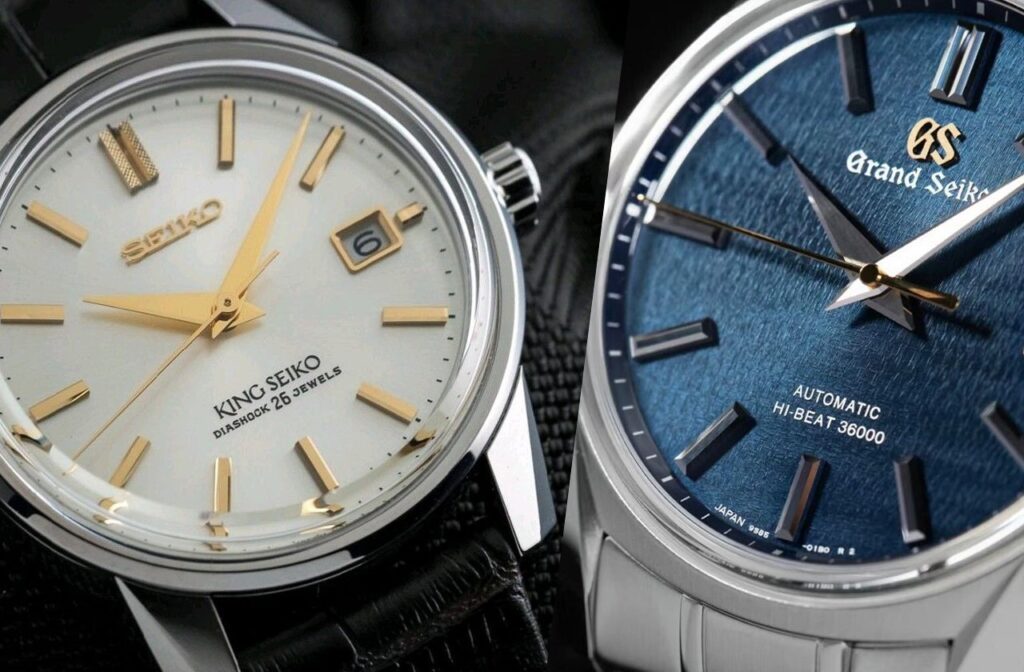
Two factories. One company. Zero mercy. The rivalry between Grand Seiko and King Seiko during the 1960s and 1970s produced some of the finest watches Japan has ever made — and collectors are only now realising how good, and how affordable, these pieces remain. This guide covers the history of the rivalry, the key differences between the two lines, and which pieces represent the best collecting opportunities in 2025.
If Grand Seiko represented Suwa Seikosha’s pursuit of ultimate accuracy, King Seiko was Daini Seikosha’s answer — a watch built with equal ambition but different philosophy. Where Grand Seiko chased observatory chronometer trials, King Seiko pushed case finishing and design innovation. The result was an internal competition that elevated both lines far beyond what either factory would have achieved alone. Understanding this rivalry is essential for any collector entering the Japanese vintage market — and our Grammar of Design guide explains the aesthetic principles that both lines shared.
The Factory War: Suwa vs Daini
Seiko operated two competing factories in the 1960s: Suwa Seikosha in Nagano Prefecture (making Grand Seiko) and Daini Seikosha in Tokyo (making King Seiko). This wasn’t accidental — Seiko’s management deliberately pitted the two factories against each other, believing that internal competition would drive innovation faster than cooperation ever could.
They were spectacularly right. Between 1960 and 1975, this rivalry produced the First Grand Seiko, the revolutionary 44GS with its Grammar of Design, the King Seiko 44KS and 45KS Hi-Beat, and ultimately Seiko’s victory at the Neuchâtel Observatory chronometer competitions — where Japanese watches beat the Swiss at their own game so decisively that the Swiss cancelled the competition rather than face further embarrassment.
The competition wasn’t abstract. Each factory had specific targets: Suwa focused on accuracy (measured in seconds per day across multiple positions), while Daini focused on case design and finishing quality. Both teams knew the other’s work and were motivated by professional pride to surpass it. The watches produced during this period reflect that intensity — every surface is finished with a care that transcends commercial necessity and enters the territory of craftsmanship for its own sake.
King Seiko: The Collector’s Best-Kept Secret
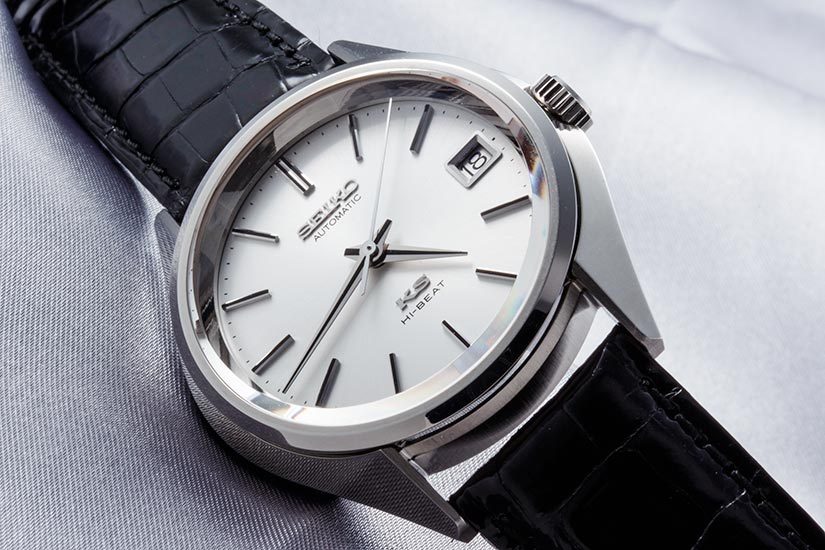
King Seiko was positioned directly below Grand Seiko in Seiko’s hierarchy — which is exactly why it’s such a compelling buy today. The finishing on King Seiko models is remarkably close to Grand Seiko — often indistinguishable to all but the most trained eyes — yet prices are consistently 30-50% lower. This pricing gap exists because King Seiko lacks the “Grand” cachet, not because the watches are materially inferior.
The King Seiko 44KS (44-9990) in our collection exemplifies this value proposition. Sharp Grammar of Design case lines, zaratsu-quality polished surfaces, manual-wind precision from the Cal. 4402, and a purity of design that rivals watches costing ten times more. At $600-1,200, the 44KS is arguably the most undervalued quality watch in the world — Japanese or Swiss.
The key King Seiko references every collector should know:
- First KS (1961) — the original King Seiko. Historical significance, clean design, excellent value at $500-900.
- 44KS (44-9990) — manual wind, Grammar of Design case, the collector’s sweet spot. $600-1,200.
- 45KS Hi-Beat — 36,000 bph, available in steel and gold. The premium choice. $800-2,000.
- 56KS — automatic, later production, most affordable entry into KS collecting. $400-700.
Collector’s Insight: The 44KS with the “Shield Medal” caseback marking (indicating Seiko’s internal chronometer standard) is the most desirable variant. These watches were individually tested and certified for accuracy before leaving the factory — the King Seiko equivalent of COSC certification. Shield Medal pieces command 20-30% premiums over standard 44KS examples.
Grand Seiko: The Accuracy Obsession
While King Seiko pushed design boundaries, Grand Seiko was waging a different battle — one measured in fractions of seconds per day. The golden era of Grand Seiko saw the development of increasingly accurate calibers, culminating in the VFA (Very Fine Adjusted) series that achieved ±2 seconds per day — a standard that shamed contemporary Swiss chronometers.
The 61GS Hi-Beat series, running at 36,000 vibrations per hour, represented the mechanical accuracy frontier. At the 1967 Neuchâtel Observatory trials, Seiko submitted 61GS-based calibers that outperformed every Swiss entry in multiple categories. The Swiss response was telling: rather than compete, they cancelled the observatory trials entirely in 1968. The official reason was “changing market conditions.” The real reason was Seiko.
For collectors, Grand Seiko’s accuracy heritage adds intangible but real value. A 56GS from our collection doesn’t just tell time — it represents a moment when Japanese engineering definitively proved it could match or exceed Swiss precision. That historical weight grows as more collectors discover the story.
The Quartz Crisis: How the Rivalry Ended
The irony of the Grand Seiko vs King Seiko rivalry is how it ended. Not because one factory won — but because Seiko itself made mechanical watches obsolete. The Seiko Quartz Astron, introduced in 1969, was the world’s first commercial quartz wristwatch. It was accurate to ±5 seconds per month — a level that no mechanical watch, regardless of factory rivalry, could approach.
King Seiko production ceased entirely in 1975. Grand Seiko continued in diminished form, eventually shifting to quartz before mechanical production resumed in the 1990s with the new 9S caliber. The fifteen-year gap when no mechanical Grand Seiko was produced (1975-1990) means that every vintage mechanical Grand Seiko and King Seiko comes from a closed production window — a finite number of watches from an unrepeatable era of competitive excellence.
This finality is what makes vintage pieces from both lines increasingly valuable. No new Helmut-era 44GS will ever be made. No new hand-wound 44KS will emerge from Daini Seikosha’s workshops. The supply is permanently fixed while global awareness — and demand — grows steadily. As our guide to vintage Seiko icons documents, appreciation across all Japanese vintage references is accelerating.
The 2021 King Seiko Revival
In 2021, Seiko revived King Seiko as a modern collection — slim, elegant, priced between $1,000 and $3,000. Modern King Seiko watches feature Grammar of Design-inspired cases, in-house 6R and 6L movements, and positioning between the mainstream Seiko Presage and premium Grand Seiko ranges.
For vintage collectors, the revival matters for two reasons. First, it validates King Seiko heritage — Seiko wouldn’t resurrect a dead brand without believing the name carries commercial weight. Second, it creates a price anchor: if modern King Seikos retail at $1,000-3,000, vintage examples with superior hand-finishing and irreplaceable historical provenance logically deserve equal or higher valuations. The market hasn’t fully absorbed this logic yet, which means opportunity remains.
Authentication Warning: Be cautious of “NOS” (New Old Stock) claims on vintage King Seiko. True NOS is extremely rare — most “NOS” pieces are polished or reassembled from mixed parts. Always request caseback and movement photos before purchasing. Check that the case serial number matches the movement era, the crown is signed with the KS emblem, and the dial printing is crisp under magnification. Our buying and shipping guide offers authentication support for every purchase.
Which Should You Collect? The Decision Framework
The choice between Grand Seiko and King Seiko depends on what you value most as a collector:
- Buy Grand Seiko if: You prioritize accuracy heritage, want the “top of line” provenance, are willing to pay more for the GS name, and value the connection to the Neuchâtel Observatory story.
- Buy King Seiko if: You prioritize value per dollar, appreciate design innovation, want to own a rising market before prices catch up, and enjoy the underdog narrative of Daini challenging Suwa.
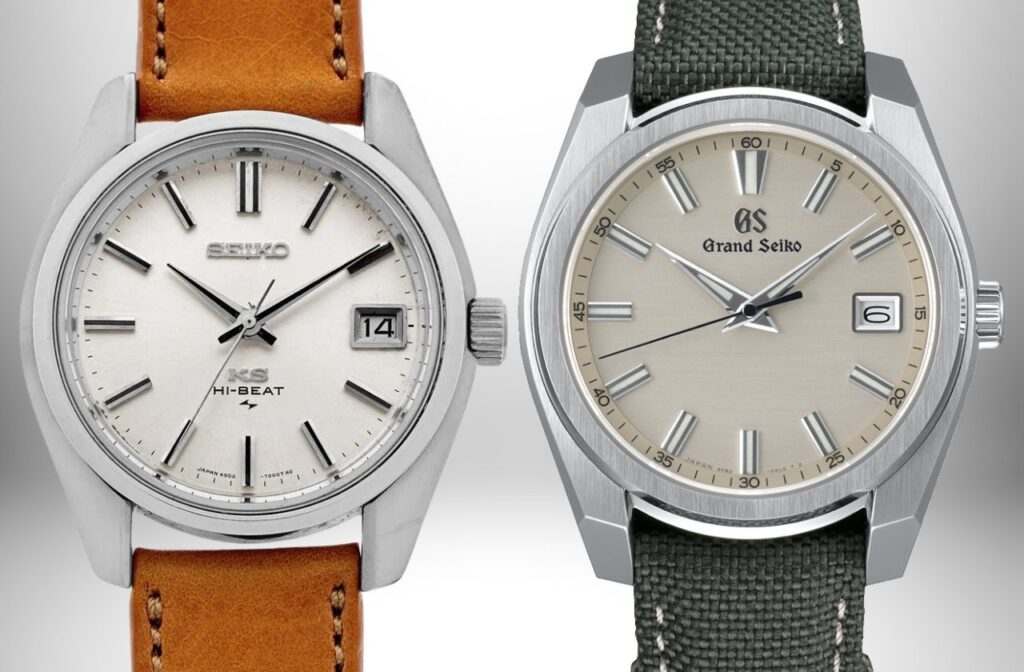
- Buy both if: You want to own the rivalry itself — a 44GS next to a 44KS, or a 61GS Hi-Beat alongside a 45KS Hi-Beat, tells the complete story of Japanese watchmaking’s golden age.
Browse our complete collection to see examples from both lines, or read the golden era of Grand Seiko for the full historical context.
Frequently Asked Questions
What is the difference between King Seiko and Grand Seiko?
Grand Seiko (Suwa factory) was Seiko’s top line, focused on accuracy and chronometer performance. King Seiko (Daini factory) was positioned just below, focused on design innovation and case finishing. Both used high-quality in-house movements and exceptional craftsmanship, but served slightly different collector priorities.
Why did King Seiko stop production in 1975?
The quartz crisis killed demand for mechanical watches in Japan. Seiko — ironically, the company that launched the quartz revolution with the 1969 Astron — pivoted its production to quartz, ending King Seiko production entirely. The line was revived in 2021 as a modern collection positioned between Seiko Presage and Grand Seiko.
Is vintage King Seiko undervalued compared to Grand Seiko?
Yes, significantly. Vintage King Seiko offers finishing quality comparable to Grand Seiko at 30-50% lower prices. The gap exists because of name recognition, not quality differences. With the 2021 brand revival boosting awareness, this pricing gap is expected to narrow over the coming years.
What is Hi-Beat in Seiko watches?
Hi-Beat refers to movements running at 36,000 vibrations per hour (10 beats per second), compared to standard 21,600 or 28,800 vph. The higher beat rate generally improves accuracy and creates a smoother seconds sweep, but it also puts more stress on escapement components, requiring more frequent service intervals (every 3-4 years versus 5-7 years for standard-beat movements).
How often should a vintage King Seiko or Grand Seiko be serviced?
Every 3-5 years for regular wear. Standard-beat automatics (28,800 bph) can stretch to 5-7 years. Hi-Beat movements (36,000 bph) need service every 3-4 years due to increased component wear. Service costs range from $150-300 for standard automatics to $250-500 for Hi-Beat calibers — significantly less than equivalent Swiss watch services.
Start your Grand Seiko & King Seiko collection
Browse all collections, learn about the Grammar of Design, or contact us for authentication help.