
Watch
Vintage Grand Seiko Reference Guide: 44GS, 45GS, 56GS & More
Mar
Vintage Grand Seiko Reference Guide: 44GS, 45GS, 56GS & More
Every vintage Grand Seiko reference tells a story — of competing factories, obsessive accuracy targets, and finishing standards that still embarrass Swiss watches costing ten times more. This guide decodes every major vintage Grand Seiko reference: what each model represents, what drives its value, and which pieces represent the best opportunities for collectors entering this rapidly appreciating market.
If you’ve read our guide to the Grammar of Design and the King Seiko vs Grand Seiko comparison, you understand the philosophy and the rivalry. This article is the practical companion — specific references, specific calibers, specific price points, and specific advice on what to buy.
The Complete Reference Table
Vintage Grand Seiko production spans roughly 1960 to 1977, with references organized by caliber family. Understanding the numbering system is the first step to navigating the market confidently.
The 44GS: The Holy Grail
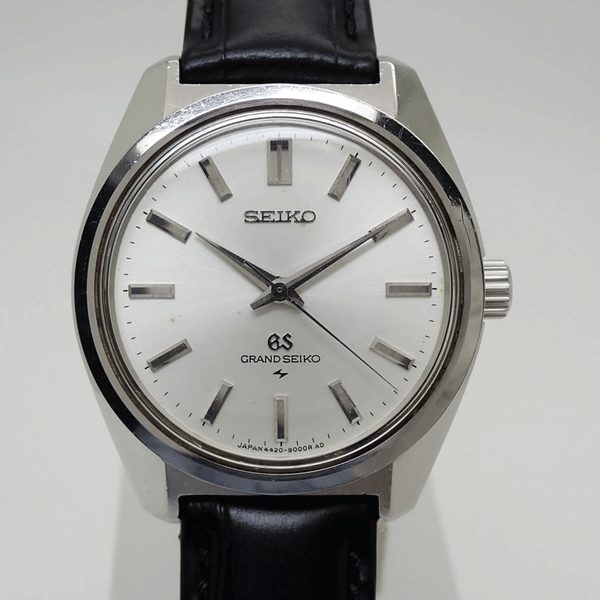
The Grand Seiko 44GS is the single most important Japanese watch ever designed. Produced for only two years (1967–1968) by Daini Seikosha, it was the first watch to fully embody Taro Tanaka’s Grammar of Design principles. Every surface is flat. Every angle is sharp. Every transition between polished and hairlined planes is abrupt and deliberate.
The case design — broad, angular lugs with flat bezel and zaratsu-polished surfaces — became the template for every Grand Seiko that followed. Modern Grand Seiko Heritage models are still direct descendants of the 44GS case language, separated by 55 years but connected by four unbreakable design principles.
Values range from $3,000 for well-worn examples to $8,000+ for clean pieces with original dials and documentation. The two-year production window means supply is inherently constrained. As Grand Seiko’s global profile rises — it’s now marketed independently from Seiko — the 44GS’s importance and price will only increase. This is the watch that started everything, and collectors are paying accordingly.
The 56GS: The Smart Entry Point
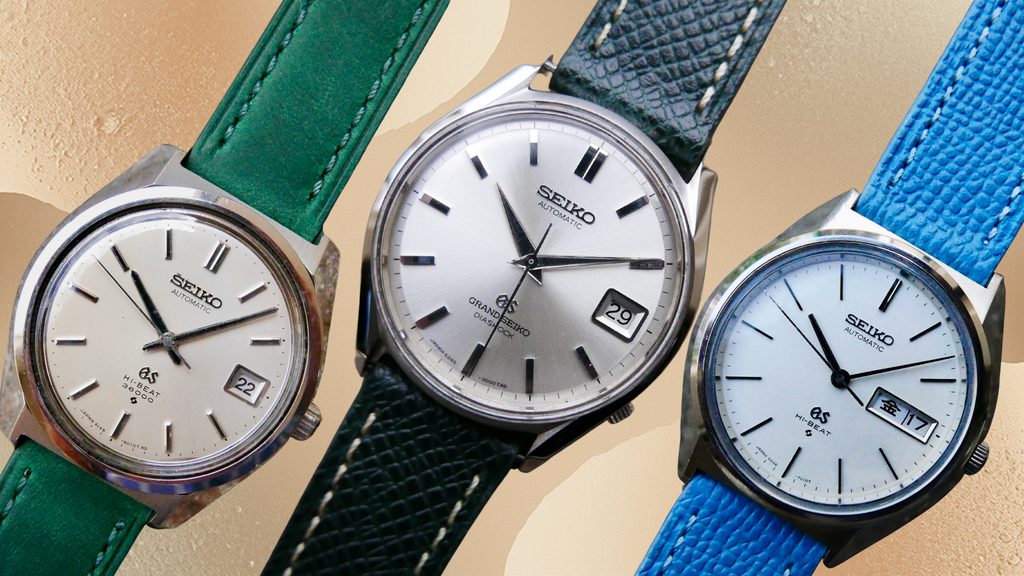
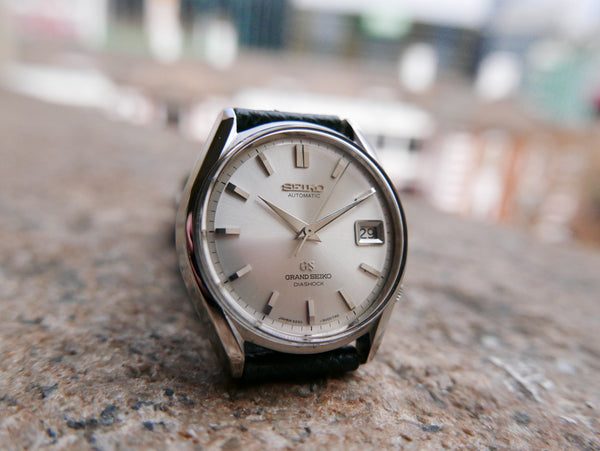
The 56GS in our collection represents the best value in vintage Grand Seiko. The Cal. 5645/5646 automatic movement — slim, reliable, and accurate — powers a beautifully proportioned watch that’s typically thinner than equivalent Swiss automatics from the same era. At 36-37mm diameter, it wears perfectly on modern wrists seeking refined proportions.
Produced in larger numbers than earlier references, the 56GS stays accessible at $800-2,500. But don’t mistake availability for inferiority — the finishing, particularly on early examples, is remarkable. Sand-textured dials, applied indices with polished facets, and zaratsu-finished cases all appear at this price point. Try finding comparable Swiss craftsmanship under $2,500 — you won’t.
The dial variants are where 56GS collecting gets interesting. The standard silver sunburst is most common, but textured variants — sand, linen, and champagne — command 20-40% premiums. Blue-dial 56GS examples, though rare, have seen 50%+ price increases over the past three years as colour variants gain collector attention across all vintage watch categories.
The 61GS Hi-Beat: The Accuracy Champion
The 61GS Hi-Beat runs at 36,000 vibrations per hour — 50% faster than standard movements. This higher beat rate translates to better positional stability, improved accuracy, and the smoothest seconds sweep in any mechanical watch of its era. For collectors who value precision as highly as aesthetics, the 61GS is the piece to own.
The VFA (Very Fine Adjusted) variants of the 61GS represent the absolute pinnacle. Individually adjusted to achieve ±2 seconds per day, VFA-grade pieces were Seiko’s answer to the Swiss chronometer establishment. At the 1967 Neuchâtel Observatory trials, 61GS-based calibers outperformed every Swiss entry — a result so devastating for Switzerland that the trials were subsequently discontinued. A VFA in good condition commands $4,000-12,000, reflecting both its rarity and its historical significance.
Collector’s Warning: Hi-Beat movements (36,000 bph) wear faster than standard-beat calibers. When buying a 61GS or VFA, service history is critical — a recently serviced piece is worth 20-30% more than an equivalent unserviced example. Budget for service every 3-4 years ($250-500) and only use watchmakers experienced with Seiko’s vintage Hi-Beat escapements. Check our buying guide for watchmaker recommendations.
The First Grand Seiko (1960): Where It All Began
The very first Grand Seiko — powered by Cal. 3180 — was Seiko’s opening statement in the luxury watch market. It declared that Japan could make watches to Swiss standards, backed by chronometer-grade accuracy and finishing that surprised the European establishment.
Original First GS pieces are rare and climbing in value ($2,000-5,000). They’re historically significant but less visually distinctive than the Grammar of Design models that followed. For investment collectors, the First GS is a heritage play. For daily wearers, the 56GS or 61GS offers more watch for the money. Both approaches are valid — it depends on whether you’re buying the story or the watch.
Dials: The Hidden Value Driver
Like Rolex Datejusts, vintage Grand Seiko values are heavily influenced by dial condition and configuration. But the Grand Seiko dial market is still immature compared to Rolex — creating opportunities for educated buyers who know what to look for.
What’s Appreciating Fastest
All vintage Grand Seiko references are rising in value — the question is pace, not direction. The market is still in its early-to-mid stages of price discovery, with significant runway remaining before values reach equilibrium with comparable Swiss pieces.
The 44GS leads the appreciation curve, driven by its historical importance as the Grammar of Design origin watch. VFA models follow closely, propelled by their accuracy heritage and the compelling Neuchâtel Observatory story. The 61GS Hi-Beat benefits from growing awareness of Seiko’s precision engineering capabilities. And the 56GS — still the most affordable entry point — is climbing as new collectors discover the extraordinary quality available at sub-$2,000 prices.
As our golden era guide documents, and the broader vintage Seiko landscape confirms, Japanese vintage watches are experiencing a structural revaluation that shows no signs of slowing. Fixed supply, growing global demand, and increasing media attention create a one-directional market dynamic that benefits early movers.
Investment Perspective: If you’re building a vintage Grand Seiko collection for both enjoyment and appreciation, diversify across references. A 56GS ($1,000), a 44KS ($800), and a 61GS ($1,500) create a $3,300 portfolio that covers three different caliber families, two factories, and three appreciation trajectories — all for less than a single new Rolex Oyster Perpetual.
Authentication: What to Check Before Buying
The vintage Grand Seiko market has fewer outright fakes than Rolex, but “Frankenwatches” (mixed-era parts assembled into a single watch) are common. Key authentication checks that protect your purchase:
- Caseback serial number: The first digit indicates the last digit of the production year. Cross-reference with known production ranges for the specific reference.
- GS medallion: The Grand Seiko emblem on the dial should show crisp, raised lettering. Blurry or flat printing indicates a refinished or replacement dial.
- Movement caliber: Must match the reference. A 56GS should contain a Cal. 5645 or 5646, not a different Seiko movement. Mismatched calibers are the most common Frankenwatch indicator.
- Crown: Genuine Grand Seiko crowns carry the GS emblem. Unsigned crowns or Seiko-only crowns indicate replacements that affect value.
- Crystal: Vintage pieces used Hardlex (Seiko’s proprietary hardened mineral glass). Plastic crystals are incorrect replacements — they should be a red flag.
Our buying and shipping guide provides authentication support for every purchase through our collection.
Frequently Asked Questions
What is the most valuable vintage Grand Seiko?
The VFA (Very Fine Adjusted) models command the highest prices at $4,000-12,000. The 44GS follows at $3,000-8,000, driven by its significance as the Grammar of Design origin. Both are genuine investment-grade vintage watches with strong appreciation trajectories.
What is the best vintage Grand Seiko to start with?
The 56GS automatic offers the best combination of quality, wearability, and price at $800-2,500. It’s affordable enough to enjoy without anxiety and well-made enough to wear daily for decades. The sand-dial variant is particularly recommended for its visual distinction.
What does Hi-Beat mean in Grand Seiko?
Hi-Beat means the balance wheel oscillates at 36,000 vibrations per hour (10 beats per second), compared to standard 28,800 vph. This higher beat rate generally improves accuracy and creates a smoother seconds sweep, but puts more stress on components — requiring service every 3-4 years instead of 5-7.
How do I authenticate a vintage Grand Seiko?
Check five things: caseback serial (first digit = last digit of year), GS medallion quality (sharp raised lettering), correct caliber for the reference, signed GS crown, and Hardlex crystal (not plastic). Any mismatch indicates a potential Frankenwatch.
Will vintage Grand Seiko continue to appreciate?
All indicators point to yes: Grand Seiko’s independent branding is driving global awareness, Japanese vintage watches are trending strongly in Western markets, and supply is permanently fixed. The 44GS and VFA are climbing fastest, with broader references following 6-12 months behind in the appreciation curve.
Explore our vintage Grand Seiko collection
Browse all collections, discover the golden era, or contact us about specific references.